
Reacting to the recent supersonic interceptor missile test by India, Sartaj Aziz, Pakistan Prime Minister's adviser on Foreign Affairs, has said that Islamabad will acquire advanced technology to improve its defence and will also raise the matter at the international arena.

The threat of wars hovers over the negotiations in Oman, but the good part is that Trump called the talks to be 'very good' and Iran's President Masoud Pezeshkian responded that they 'constitute a step forward', points out Ambassador M K Bhadrakumar.

'Some success has been achieved in raising the costs of terrorism for Pakistan.'

Trump claims the United States is performing exceptionally well in its ongoing conflict with Iran, citing weakened Iranian military capabilities and a strong US position.

The missile is a new version of an existing nuclear capable missile.

The missile has a strike range of 2000 km, the sources said soon after it blasted off from a mobile launcher at the Launch Complex-4 of the Integrated Test Range, the sources said.

US central command said that several US personnel are undergoing evaluation for "traumatic brain injuries" and at least one Iraqi service member was wounded in the attack.

It's a strategic approach in which the country's military and defence mechanisms evolve continuously in tandem with emerging threats. The new strategy anticipates events and prepares to counter those proactively.

In December last year, India had approved the purchase of five S-400s for $5 billion or Rs 39,000 crore, said sources.

'Strikes into the Gulf countries are proof that the security guarantees offered by the US are ineffective and that the Gulf countries cannot rely on American security assurances for their safety.'

Seconds into the test, the anti-ballistic missile deviated from its planned path and it quickly became clear that it would not hit the target.
'This strike has certainly enhanced your image.' 'Otherwise, people would have called you a damp squib, capable of doing nothing except talking big.'

Low-level lightweight radars; very short-range air defence systems (launchers and missiles); remotely piloted aerial vehicles; loitering munitions, including vertical take-off and landing systems; different kinds of drones; bullet-proof vests; ballistic helmets; quick-reaction fighting vehicles -- heavy and medium; and night sights for rifles (aiming devices that are visible in low light).
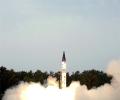
India on Friday successfully test-fired its indigenously developed nuclear-capable Agni-I ballistic missile with a strike range of 700 km from a test range off Odisha coast as part of a user trial by the army.
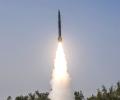
The proposal is also important as it comes at a time when the Indian forces are working on the creation of a rocket force which has been in discussion at the highest levels in the Defence Ministry.

India's second nuclear-powered ballistic missile submarine was commissioned into the Navy on Thursday in the presence of Defence Minister Rajnath Singh who said this will further strengthen the country's nuclear triad and enhance nuclear deterrence.

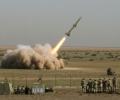
The state-of-the-art indigenous missile targeting an UAV 'Banshee', was fired from the launch complex-III of the Integrated Test Range at Chandipur near Balasore on Tuesday afternoon.

In a major boost to its military might, India on Wednesday successfully test-fired surface-to-surface strategic missile Agni-5 that can strike targets at ranges up to 5,000 km with a very high degree of accuracy, officials said.

Polish Prime Minister Donald Tusk confirmed that the country's airspace had been violated by "a huge number of Russian drones" which were shot down by its military.

This is the latest in a string of tests by North Korea in defiance of United Nations sanctions.

'We were in a heavily nuclearised environment. China had tested for Pakistan in the 1980s and helped their missile programme stay just one step behind us.'

'In today's launch, the 'Pralay' missile was tested for heavier payload and different range to prove the precision and lethality of the weapon'

Saraswat played a key role in developing a series of missiles at a time when India faced tight international technology sanctions.
'Pakistan was very mature in the way it dealt with the incident.' 'India too owned up to the accident.' 'The whole incident was resolved quite amicably.' 'Both countries should be proud of how they have handled this situation.'
The People's Liberation Army Rocket (Missile) Force tested the new missile in the Bohai Sea.

Describing the trial as a "complete success", they said all mission objectives were met during the test-fire. All radars, tracking systems and range stations tracked and monitored the flight performance of the missile, which was launched with support of a mobile launcher.

Powering the Agni-1P will be the cutting-edge technologies developed for the Agni-4 and Agni-5 missiles.

Anil Varshney, a Senior Systems Engineer with Huntsville missile defence contractor Parsons Corporation, recently filed a federal lawsuit alleging systemic discriminatory actions that left him jobless in October last year.

In 2013, India had displayed the Inter Continental Ballistic Missile Agni V during the Republic Day Parade. The chief guest at that time was Bhutanese King Jigme Khesar Namgyel Wangchuck.

The delegations from the US and Iran head to Islamabad on Friday, carrying a ceasefire that is already fraying, a Strait that is technically open and practically closed, and a negotiating agenda that would challenge even parties actually negotiating in good faith, which these groups are not. Prem Panicker continues his must read blog on the Iran War.

Pakistan has expressed serious concern over India's recent development of an anti-ballistic missile system

Will the unpredictable North Korean leader provoke conflict on the Korean peninsula?

The Israel Defence Forces said that missile destroyers were deployed 'in accordance with the assessment of the situation, and as part of the increased defence efforts in the region'.

India on Sunday successfully test-fired its medium-range nuclear-capable Agni-II missile with a strike range of more than 2,000 km from the Wheeler Island off Odisha coast as part of a user trial by the army.

India on Friday night successfully conducted maiden night test of its indigenously developed nuclear-capable Agni-I ballistic missile with strike range of 700 km from a test range off Odisha coast as part of a user trial by the Army.
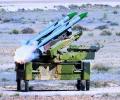
Ordering more Akash systems is essential for the Indian defence industry.

China was the first country to export such sensitive equipment to Pakistan
'When one air force (India's) hits the other's airbases with impunity and that air force (Pakistan's) is not able to respond, then the air force, which has put the other's airbases out of commission, has won.'
India's nuclear-capable, surface-to-surface Agni-II ballistic missile, with a strike range of 2,000 kms, was on Friday test-fired as part of user trial by the army from the Wheeler Island off Orissa coast.
